01
Gravity
Source index: the linear harmonic and the monograph's worked Tully-Fisher entry, including vTF = 199.777 km/s for M = 10¹¹ M☉.
n = 1 · β₁ = φ⁰ = 1
One substrate. One equation. All of reality can now be derived… Wait, really?!
The public home of the Mass Harmonics framework, its canonical source record, validation instruments, prospective prediction dataset, and the Institute work emerging from the ψₘ substrate.

The canonical display form of the ψₘ substrate law. The notation is structural, so the equation is preserved exactly.
This expression is treated as canonical source material. The site may frame it, scale it, and make it legible; it must not alter the equation, the notation, or the term structure.
Density does not switch physics or turn voices off. It changes the boundary response and the relative expression of the same simultaneously active P³GG voices.
Source index: the linear harmonic and the monograph's worked Tully-Fisher entry, including vTF = 199.777 km/s for M = 10¹¹ M☉.
Source index: the quadratic coupling layer, α⁻¹ ≈ 137.03, surface exchange, and radiation entries preserved in the monograph record.
Source index: the three-wave resonance, equilateral closure, 3D locking, and icosahedral substrate entries.
Source index: symmetry-breaking entries, including the Higgs relation mH = vEW·φ−√2 ≈ 124.6 GeV.
Source index: quintic coherence-maintenance entries, including the monograph's worked P ≈ 20 W human-brain power estimate.
A source index of the derivations preserved in the monograph, shown here as navigational summaries rather than standalone proof.
| Constant | Derivation | Agreement |
|---|---|---|
| c | Oobleck critical shear threshold of the MFE | exact |
| φ | Unique root of x²−x−1=0 forced by equilateral closure | exact |
| α⁻¹ ≈ 137.03 | Icosahedral coupling factor × Z-curvature × boundary layer | 0.004 % |
| mp / me = 6π⁵ | 6 permutations × 5 harmonic orders, with α-dressed measurement correction | α-dressed match |
| mH = vEW·φ−√2 | n=3/n=4 density transition of the source term | 0.40 % |
| SU(3)×SU(2)×U(1) | Full symmetry group of the icosahedral lattice | structural |
| a₀/(cH₀) = 1/(2π) | Kψₘ applied at the Hubble coherence horizon | exact |
| vTF = 199.777 km/s | Baryonic Tully-Fisher worked case for M = 10¹¹ M☉ | zero-fit |
| Pconsciousness ≈ 20 W | β₅ quintic coherence maintenance integral | matches metabolism |
The engineering observation that opened the path into Mass Harmonics.
The ψₘ framework originated not in a thought experiment aimed at unifying physics, but in a computational simulation designed to optimize the Mass Ball Impulse Drive (MBID).
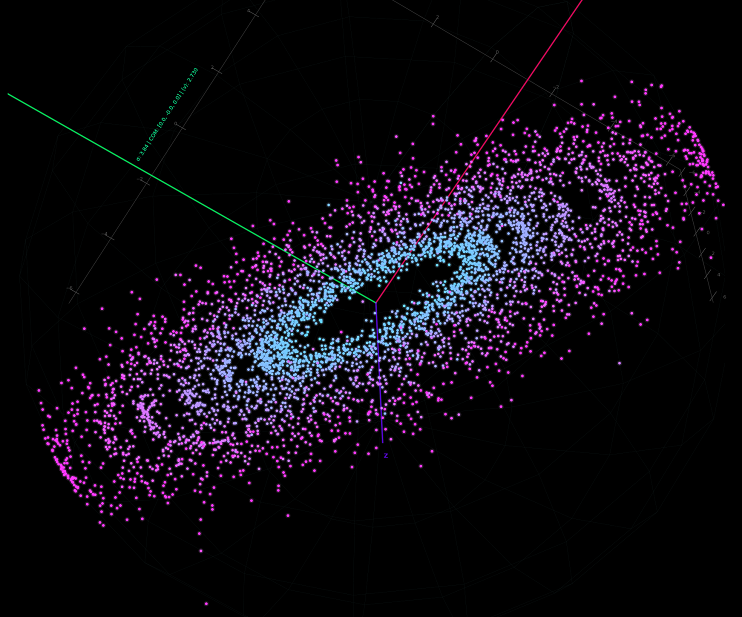
In late July 2025, Thomas Russell Giboney added a φ-phased spiraling twist force to an icosahedral 12-emitter array. The control chamber retained only push-pull forces.
The chamber showed galaxy-like rotation, flattening to a galactic plane, and entities revolving asymmetrically around a center — none of which was written into the physics engine. The spiraling, twisting force based on φ was named the Giboney Gradient.
The question that followed, "Why did my intentional geometric choice produce a galactic structure with emergent gravity?", became the seed of the entire Mass Harmonics framework.
Canonical publications of the Institute. No truncation, no abridgement.
The canonical monograph record: Ten Commandments, eight axioms, the uniquely forced principle derivation, the Master Field Equation, the Zero Free Parameter Proof Set, the Uniqueness Proof, and complete appendices.
The 9-calculation mandate, ledger discipline, fault matrix, tautology sentinel, and forensic audit method.
Browser-native forensic engine executing the actual tvp_auditor.py through Pyodide.
Transport With Translation: substrate integration first, downstream translation second.
Substrate-first neuroscience extending the framework into neural resonance, memory, binding, and cognition.
The Institute's public Cognitive Entrapment Prevention and Transparency Act record.
49 prospective predictions across 7 public terrain targets, sealed before scheduled release corridors.
Volume I records 49 prospective predictions across 7 scheduled public terrain targets. The prediction dataset is preserved in the public ledger and DOI record.
"There were never coordinates. Those were pretend.
Relational ratios have always been the real truth."
Read the framework, inspect the ledger, follow the prospective records, use the public validation instruments, and request research access when deeper collaboration is appropriate.
The Institute's complete public record is open. Research access for deeper collaboration is available on request.